

Never Trust a Perfect Map
On fantasy maps and imperfection.

The only people who love a good map more than fantasy readers are fantasy authors. Mostly because we’re simple folk who are constantly messing up logistical details if we don’t record them somewhere for future reference1, but also because they look neat.
Somewhere along the way, a certain kind of writer—it’s me, I’m a certain kind of writer—can get hung up on accuracy when making a map. And yeah, it’s important to learn a few things about how rivers flow toward the oceans unless there’s a specific in-world reason for them to do the opposite. And there should probably be some thought about how landmasses are formed, where cities would naturally crop up, and what the general scale of your map is in regards to how long it takes your characters to get from X’aele’brødu’xu to Vincouver2.
Throughout the years, I’ve seen readers criticize maps for not being precise enough, internally consistent, or non-scientific. Some readers want coastlines to make perfect sense, trade routes to be completely logical, and for distances to be consistent across the world.
I suppose that kind of map can be useful, but it’s not the kind of map I trust.
Because maps in stories are anything but neutral. They’re expressions of perspective, and they tell you how a character—or culture—understands the world. The moment you start treating fantasy maps as objective truth, that in-world perspective gets flattened into something far less interesting.
A perfect map implies a perfect understanding of the world.
And that’s almost never true—either in fiction or in real life.
Look at this gorgeous map from Ottoman cartographer Piri Reis’ Kitab-ı Bahriye (Book of Seafaring):
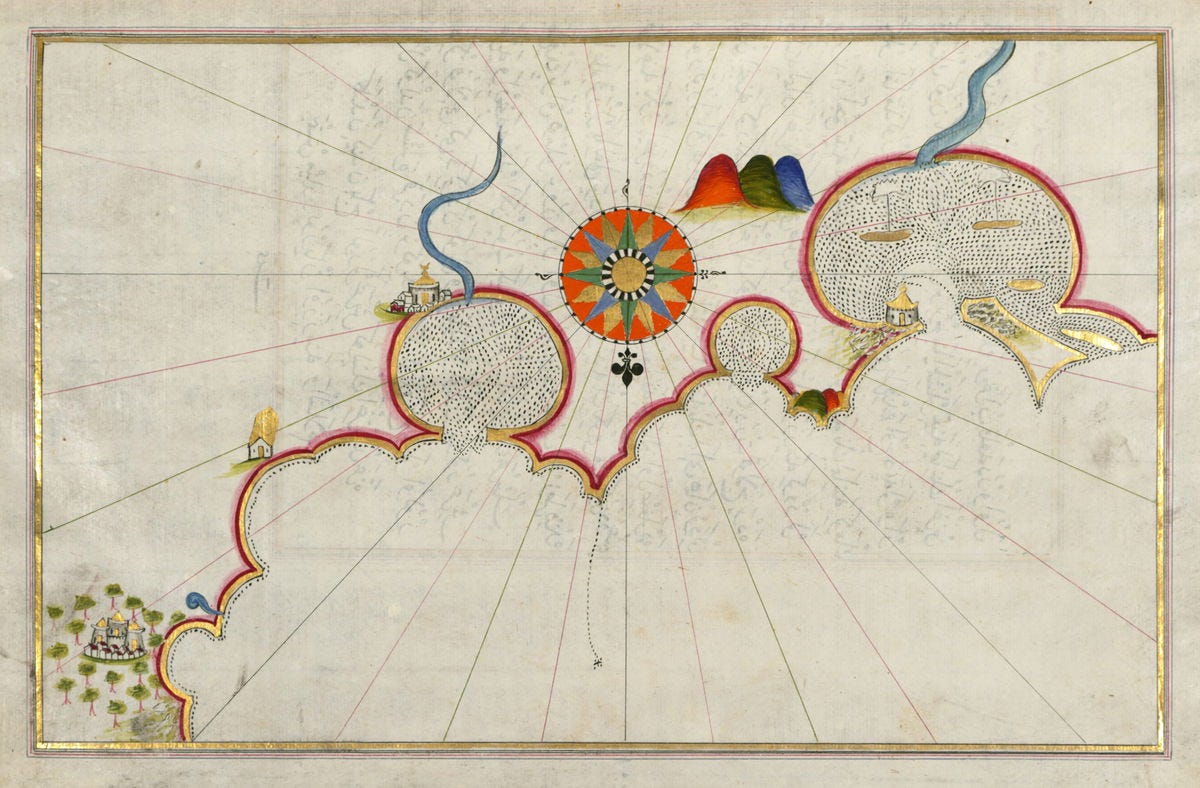
Piri Reis made some of the most accurate maps of this time, but this is anything but geographically perfect.
Another by Lord Nicolas the German:
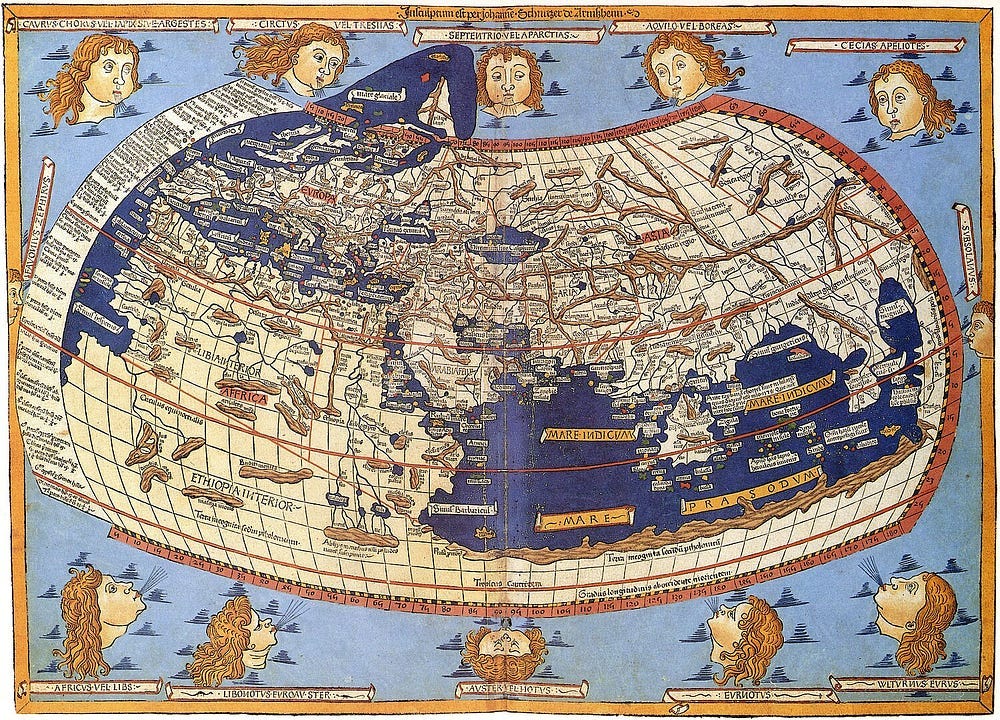
A merchant maps routes, not places. What matters is distance, cost, and reliability. A sailor maps notable landmarks, dangerous currents, and safe harbors. A soldier might be more invested in elevation, choke points, and defensible positions than notable shrines, libraries, or other cultural landmarks.
My own map for stories set in Tellen is far from geographically sound. Yes, there are some historical reasons for that, but mostly it’s a map of the world as the people of that time understand it.
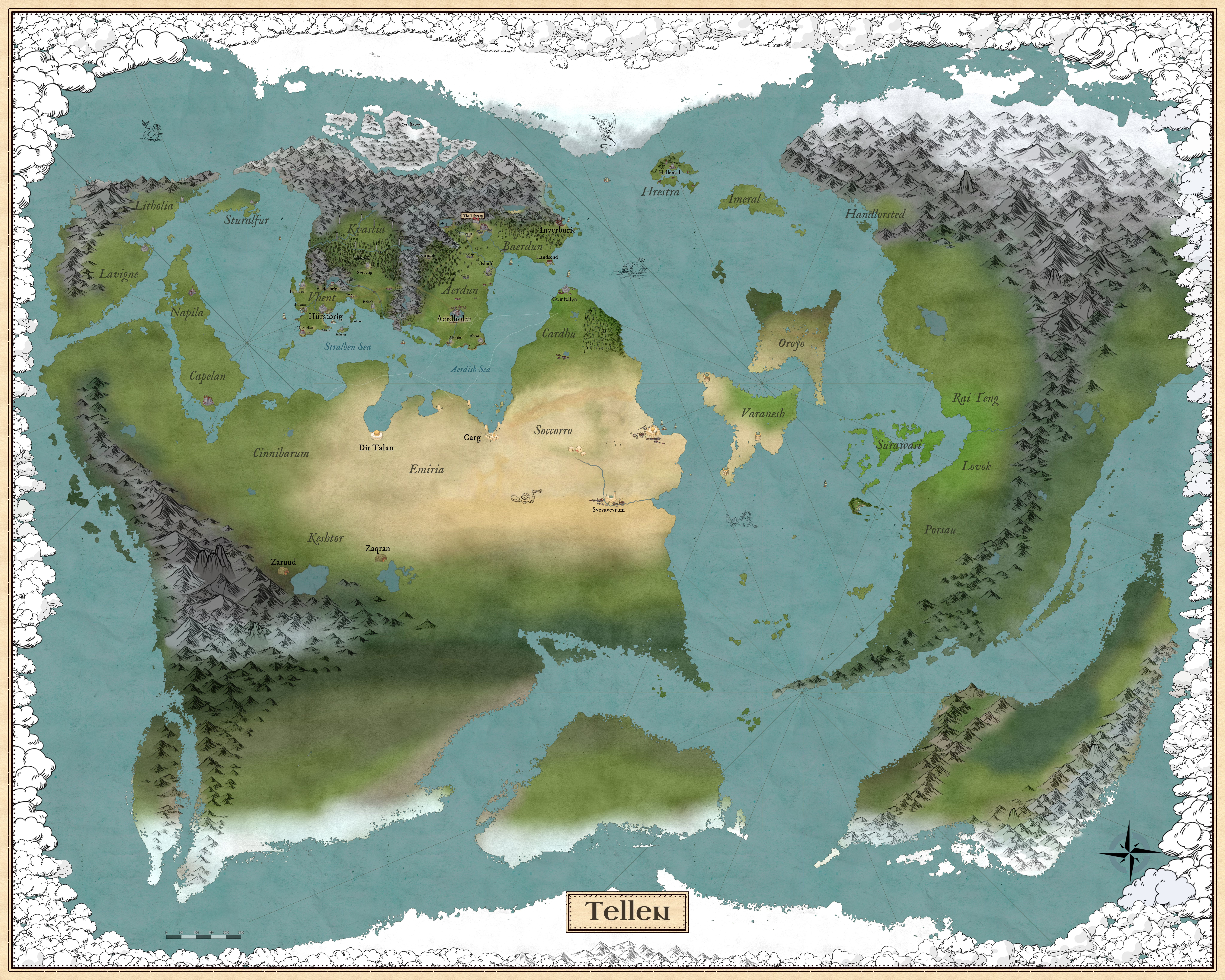
Landmasses aren’t to scale, sailing distances vary by perceived distance, and in a meta-sense, the map reflects my understanding of the world as I develop it more than anything else. The landscape shifts and changes as I need to suit any given story—at least until a location is locked-in after publication.
Readers don’t move through a world with a map and compass, they move through it with a point of view. Perfect maps erase that. They give the reader a false impression that they know how to navigate the world better than the characters. When I’m reading a book in a second-world setting, I don’t want to be wondering why a character chose to take what seems like an inefficient route based on the map at the beginning of the book.
This is why I go into every fantasy story assuming the map is a matter of in-world perspective. A perspective that only the characters can reveal.
If I had the time3, I’d create several maps of Tellen from the perspective of each different culture. How much fun would be to see how they differ? What they prioritize and ignore? The disagreement between the respective maps would be a story in and of itself.
In both fiction and reality, the most revealing maps are the ones that show you not just where things are, but how someone believes the world works.
And that’s always a little messy.
Until next time, I’ll see you in the map room!
-mark
Don’t even get me started on keep track of time in a story.
Which is definitely not a direct fantasy copy of Vancouver.
Even better, if I had the money to simply hire someone to make them for me.